
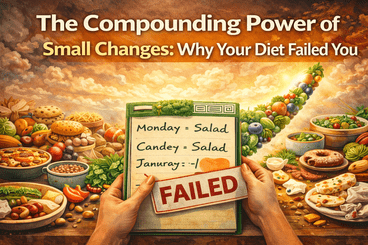

The Compounding Power of Small Changes: Why Your Diet Failed You
It’s a familiar story. January 1st arrives, filled with the promise of a “new you.” You’ve committed to a radical dietary overhaul—a restrictive, complex plan that promises rapid transformation. For a week, maybe two, you’re a model of discipline. But soon, the cracks appear. The rigidity becomes exhausting, the cravings intensify, and a single slip-up feels like a catastrophic failure. By February, the diet is a distant memory, and a sense of defeat sets in. This cycle, the all-or-nothing “New Year’s Resolution Diet,” is practically designed for failure. It ignores the fundamental truth of human biology and psychology: lasting change is not born from seismic shifts, but from small, consistent actions that compound over time.
This chapter explores why those grand overhauls are so often doomed and how a gentler, more sustainable approach—focusing on small, incremental additions rather than drastic subtractions—is the true key to unlocking profound and lasting health benefits. We will delve into the science of habit formation and the compounding magic of nutritional diversity, demonstrating why focusing on patterns, not perfection, is the most powerful strategy for transforming your well-being.
Why Do Restrictive Diets and Overhauls Fail?
Restrictive diets and radical overhauls fail because they trigger psychological resistance and are biologically unsustainable. These approaches often frame food as the enemy and rely on willpower, a finite resource. When you drastically cut calories or eliminate entire food groups, your body’s survival instincts kick in, increasing cravings and slowing metabolism, creating a cycle of deprivation and eventual rebound.
This approach is a setup for what psychologists call “abstinence violation effect.” When you inevitably deviate from the strict rules—a piece of cake at a birthday party, a less-than-perfect meal—you feel you’ve failed completely. This sense of failure often leads to abandoning the effort altogether. Instead of fostering a healthy relationship with food, restrictive diets create anxiety and a pattern of yo-yo dieting that can be more harmful than the initial dietary pattern. They demand perfection in an imperfect world, an impossible standard that ignores the complexities of daily life.
How Do Nutritional Benefits Compound Over Time?
Nutritional benefits compound over time through the consistent application of small, positive changes that build upon each other, creating a powerful, cumulative impact on your health. Much like compound interest in finance, each healthy choice is a small investment in your well-being that grows exponentially, leading to significant long-term returns in energy, vitality, and disease prevention.
Imagine adding just one new plant to your meals each day. It seems insignificant. A handful of spinach in your smoothie, a sprinkle of herbs on your eggs, a side of roasted broccoli with dinner. On its own, it’s just one plant. But after a week, you’ve effortlessly added seven new types of plants to your diet. After a month, it’s thirty. Over a year, you will have consumed hundreds of different plant varieties, each feeding a unique set of beneficial gut microbes. This is the core of our first rule: aim for 30 different plants per week. This simple practice diversifies your gut microbiome, which is linked to improved immunity, better mental health, and a lower risk of chronic disease. The initial effort is small, but the eventual payoff is a complete transformation of your internal ecosystem.
Why Should You Focus on Patterns, Not Perfection?
Focusing on patterns, not perfection, is crucial because it builds a resilient and positive long-term relationship with food, fostering consistency over intensity. This mindset acknowledges that life is not a controlled experiment; there will be celebrations, stressful days, and imperfect meals. A single “unhealthy” choice does not negate the benefits of an overall healthy eating pattern.
Perfection is an illusion that leads to burnout. A pattern, however, is a flexible framework. It’s about the bigger picture. Did you eat a variety of colorful foods this week? Did you generally get close to the recommended daily intake of fruits and vegetables? This is where our other two rules come into play, creating a simple, memorable pattern for success.
| The Lively Three Rules: A Pattern for Health | | :— | :— | | 1. 30 Plants Per Week | Why it Matters: Your gut microbiome thrives on diversity. Each plant species feeds different beneficial bacteria, which in turn support your immune system, mood, and metabolism. Most people eat fewer than 10, but aiming for 30 is an achievable goal that pays massive dividends. | | 2. 7 Colors Per Week | Why it Matters: The vibrant colors in fruits and vegetables are created by different phytonutrients. These compounds have unique health benefits, from protecting your brain to reducing inflammation. Eating a rainbow ensures you’re getting a wide spectrum of these protective nutrients. | | 3. 500g Fruits & Veg Per Day | Why it Matters: This is the global benchmark for health, supported by decades of research. Half a kilo per day is strongly linked to a lower risk of nearly every major chronic illness, including heart disease, diabetes, and cancer. It’s a simple, powerful target for daily wellness. |
This framework shifts the focus from rigid rules to a gentle, guiding pattern. It’s not about a perfect day; it’s about a good week. It’s not about restriction; it’s about joyful addition. This approach builds confidence and makes healthy eating feel like an act of self-care, not self-punishment.
How to Build Lasting Healthy Habits?
Building lasting healthy habits is achieved by starting with changes that are so small they are almost effortless, and then gradually building on them. This method, often called “atomic habits,” bypasses the need for massive bursts of motivation and instead relies on the power of consistency. The key is to make the new habit obvious, attractive, easy, and satisfying.
For example, instead of committing to eating 500g of vegetables tomorrow, start by adding a single cherry tomato to your lunch. The next day, add two. Make it easy by having pre-washed vegetables ready in your fridge (making it obvious). Make it attractive by pairing them with a dip you love. Make it satisfying by tracking your progress and celebrating the small wins. This slow, steady progression builds a new baseline for your behavior without overwhelming your willpower. Over time, these tiny habits become automatic, forming the foundation of a new, healthier lifestyle.
Your journey to better health doesn’t have to be a punishing ordeal. It can be a gentle, empowering process of addition and discovery. Let The Lively Three app be your guide on this journey. Track your 30 plants and 7 colors, celebrate your progress with a rising Weekly Health Score, and discover a new way of eating that nourishes your body and respects your life.
Download the app today and let the compounding begin.
